Coding agents have changed the way we build software. Most engineers still need to accept this reality, but the days of writing syntax are over. These days, we tell an agent which problem to solve.
But while most of us are still coming to terms with this new reality, some of us are taking it further. Why work with one agent if you can spawn a legion?
The silicon brains can handle hundreds of tasks simultaneously. Our carbon brain struggles with context switching and multitasking.
So, while a simple terminal is enough to handle one agent, we need something new to manage a horde.
Clever people are re-inventing the nature of the IDE. Since we are no longer writing code, our development environment shouldn’t be centred around an editor. Tools like OpenAI’s Codex desktop and Conductor offer a fascinating view into what the IDE of the future could be.
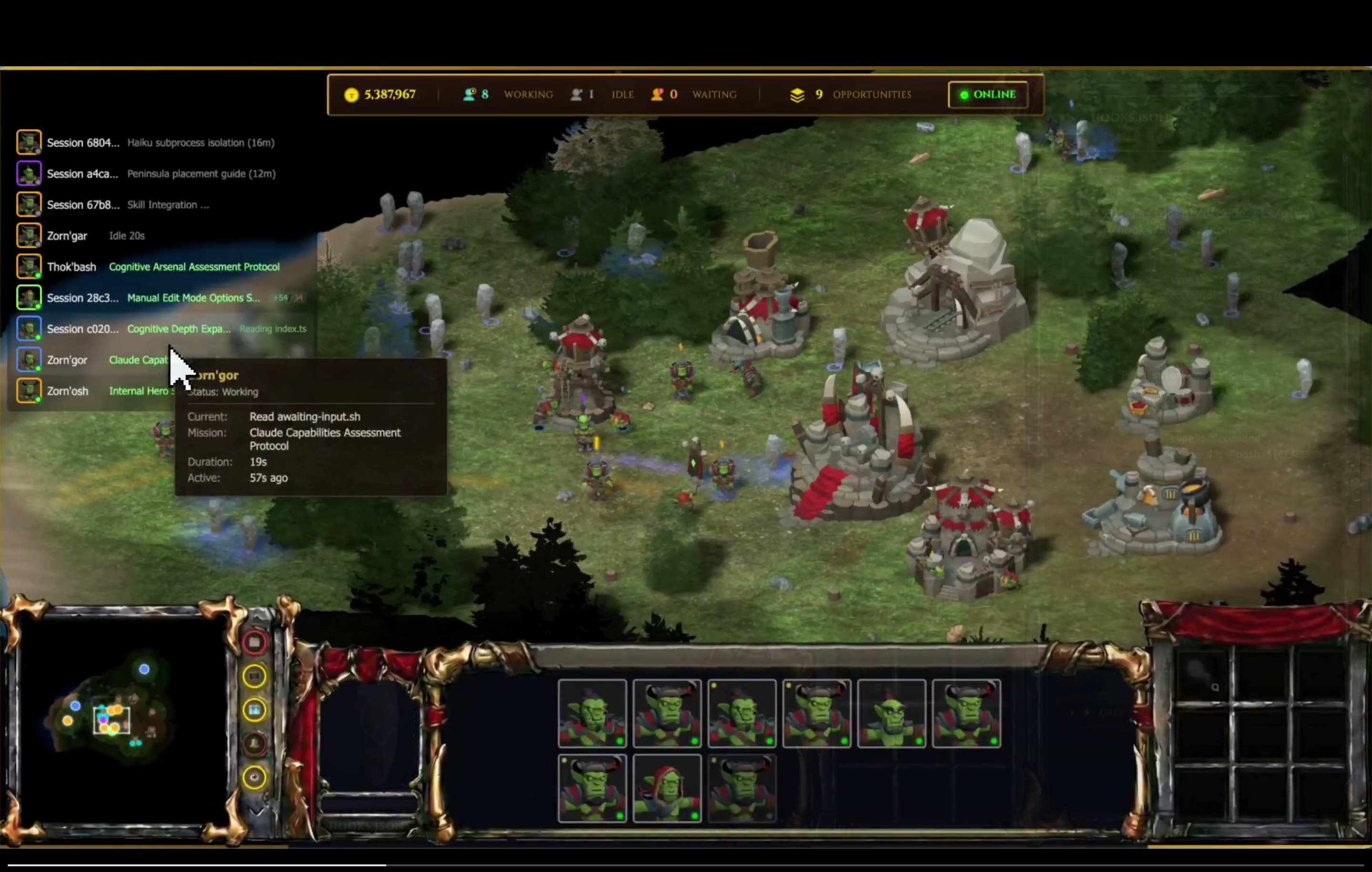
A month ago, a silly tweet caught my eye. @idosal1 posted a screenshot of a Warcraft-style IDE called Agentcraft. RTS players have been training their entire life to manage multiple agents!
When the project turned out not to be a joke, I paid attention, and what I discovered was a silly, whimsical interface with some radical, fresh ideas. While it’s unlikely that the VS Code of the future will be Orc-themed, there are some brilliant features that will be incorporated in the IDE of the future.
Turn-based games like XCom feel very similar to running a single agent. You give your instructions, you wait for the aliens’ turn and react to the outcome. And then you wait again.
In RTS games, there is no waiting. This kind of game rewards both fast tactical decision-making and keeping the overall strategy in mind. Its interface is optimised to support multitasking.
Agentcraft applies that interface to coding agents.
What’s not there yet
Now, it’s not a perfect package. Some of the choices feel limiting.
Each map is a single repository, which defeats the point of multi-agent development. When marketing decides Ferrari red is our new company colour, I want to tell my agents to change all our apps. At once. Not map per map.
Multiselect isn’t working yet. Sometimes I would like to instruct multiple agents with a single prompt. Or close a lot of them with one click.
Multiplayer is missing. Collaborative software development is also changing. We need better tools to manage teams of engineers managing armies of agents.
Its very basic git support, and the lack of an editor is a pain. And visualising files as rocks is a lot harder to navigate than a folder structure.
But these are basic gripes. What I care about are the fresh new concepts:
Quests
The Quest window shows us what our Orcs should work on. While it’s possible to spin up a grunt and tell him what to do, the quests have a clever spin. As an engineer, I’ve always found it clumsy that Jira was separate from IntelliJ. The discussions about the work live in a tool outside the IDE. Quests are the end result of prior conversations between PMs and engineers. Accepting a quest is the equivalent of assigning a Jira ticket to yourself.
But the new cool thing is that a hero emerges as soon as you accept and starts working on the quest immediately. That makes sense in the era of agents. It’s way faster than opening Claude Code and explaining what to build. “I’ll take care of these three bugs” is going to feel normal in the IDE of the future.
Shortcuts
Each Orc can be instructed to test, review, document, or simplify with a single click. Shortcuts to avoid typing recurring prompts are a no-brainer. We spend too much time typing the same instructions over-and-over again. Add a test. Stop the server. Rebuild the app. Project-specific, sharable prompt reuse feels like a logical next step.
Agent types
Agentcraft supports spawning multiple types of agents. While this feature is currently a bit underwhelming, the promise is real. Agents can have different system prompts. A designer will look at other things than an architect. But this concept can be extended even more. While all agents are currently Orc grunts, more massive beasts can be added in the future to keep an eye on token spending. A large Opus-dragon for heavy planning, a tiny Haiku-peon for document completion. Or even a Mistral Mage to keep certain spells in the EU region. Visualising the agent types offers a lot of possibilities.
Context Forking
I believe agent context is an underappreciated superpower. It’s a shared understanding between a human and their Orc. The IDE of the future will treat context as a first-class citizen. AgentCraft has a neat idea in the form of a “Spawn new Orc with same context” button. I love that. After refactoring the first service, it makes sense to spawn multiple Orcs with that know-how to refactor the rest. A lot of work these days consists of showing the agent how to do something and then applying it to the rest of the code. It feels logical that the IDE of the future will treat the context as the powertool it is.
Skills interface
CLI tools are just starting to experiment with skills, but there are two things that feel wrong about skills today. The first one is the security issue. Installing an unvetted Python script is risky. The second issue is a capacity issue. Skills are all-or-nothing. Install the imagegen skill in Codex, and you now have it for every project. That’s not good.
Agentcraft treats skills like pickups, and that feels a bit messy. But treating them like spells to research is an interesting path. You don’t want to research Blizzard for every quest. You don’t want to research imagegen for every project. Skills should be team-mandated and opt-in per repo.
A Warcraft-themed experiment is not a professional productivity tool. But Agentcraft is a laboratory of great ideas. It challenges the editor-first nature of software development by applying a familiar interface optimised for multitasking.
There is very little chance that the IDE of the future will involve commanding an army of goblins to fix bugs. But, a few years from now, when it will be a mature editor-free productivity environment, lots of these good ideas will be implemented.
While it will have the sleek design of Linear, it will have the heart of Agentcraft.