AI tools are overhyped, but their results undeniable. They turbocharge software engineers.
Product managers, on the other hand, struggle to find the same productivity boost. Sure, they can create an interactive mockup in Lovable, but that’s of very limited use on brownfield products.
So what can a PM do?
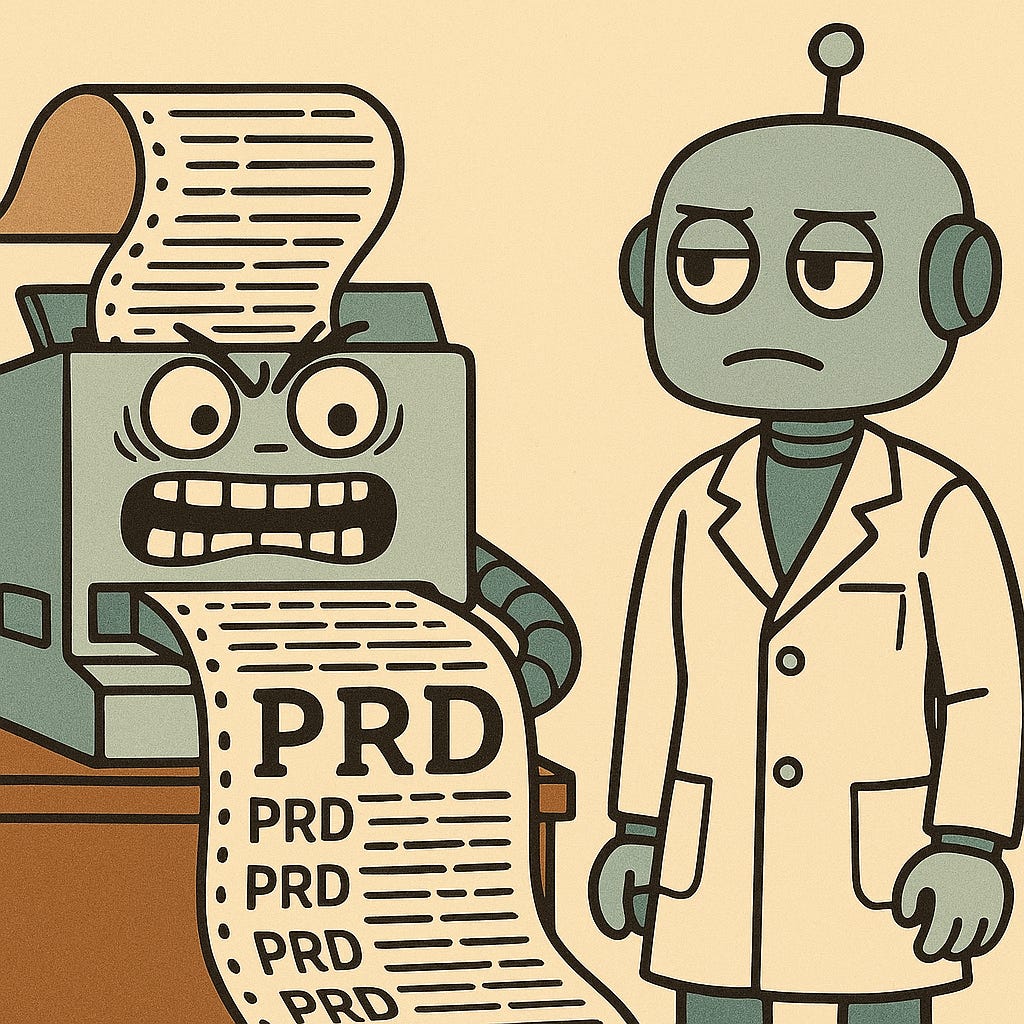
There is a tempting, popular idea out there that leads to a dead-end street. The cardinal sin of AI-powered product management is having Claude generate your Product Requirement Documents for you. It’s unfortunate how popular that sin is getting.
A PM pastes a handful of bullet points into their AI Assistant and out rolls a 15-page, good-looking specification document. It looks professional at first glance and feels like a time-saver, but it’s neither.
We’ve learned from our Waterfall days that specification is hard, expensive and error-prone. It’s a hard law of software development that requirements written in a hurry, always lead to confusion, rework and bugs. That law doesn’t change because the author is made of silicon.
If you take one thing away from this newsletter, let it be this: never-ever autogenerate requirement docs. Please.
Another, even more tempting and worse idea is to feed such a PRD into a GPT. After rolling out a smörgåsbord of talk-to-your-PDF features, product managers are now thinking: What if you could talk to your PRD?
Since specification documents never feel complete and developers always have pesky questions, why not let PM Siri answer them? The blind spot, of course, is that LLMs are people pleasers. ChatGPT has never faced a question it couldn’t hallucinate an answer to.
So, if generating PRDs leads to nonsensical specifications and talking to them makes it worse, is AI-powered PM productivity a complete dead end?
One interesting application is to feed your (handwritten) specification documents into something like NotebookLM. This would allow team members to ask the bot questions across multiple documents. The beauty of NotebookLM is that it hardly hallucinates. For every claim it makes, it provides a reference to the original source.
AnythingLLM is a similar, more powerful platform that is surprisingly painless to set up. It also provides references and even has a “query mode” where it refuses to answer if it can’t find a good source. With its API and MCP support, it’s easy to imagine automatically feeding Jira tickets, meeting minutes and Notion pages into a centralised Product Assistant.
And that might well be the future of AI-powered product management: shaping this interactive knowledge base that grows as the product evolves. Curating and maintaining the system while picking its silicon brain for new insights.
Isn’t that a much more fascinating future than just generating AI slop?