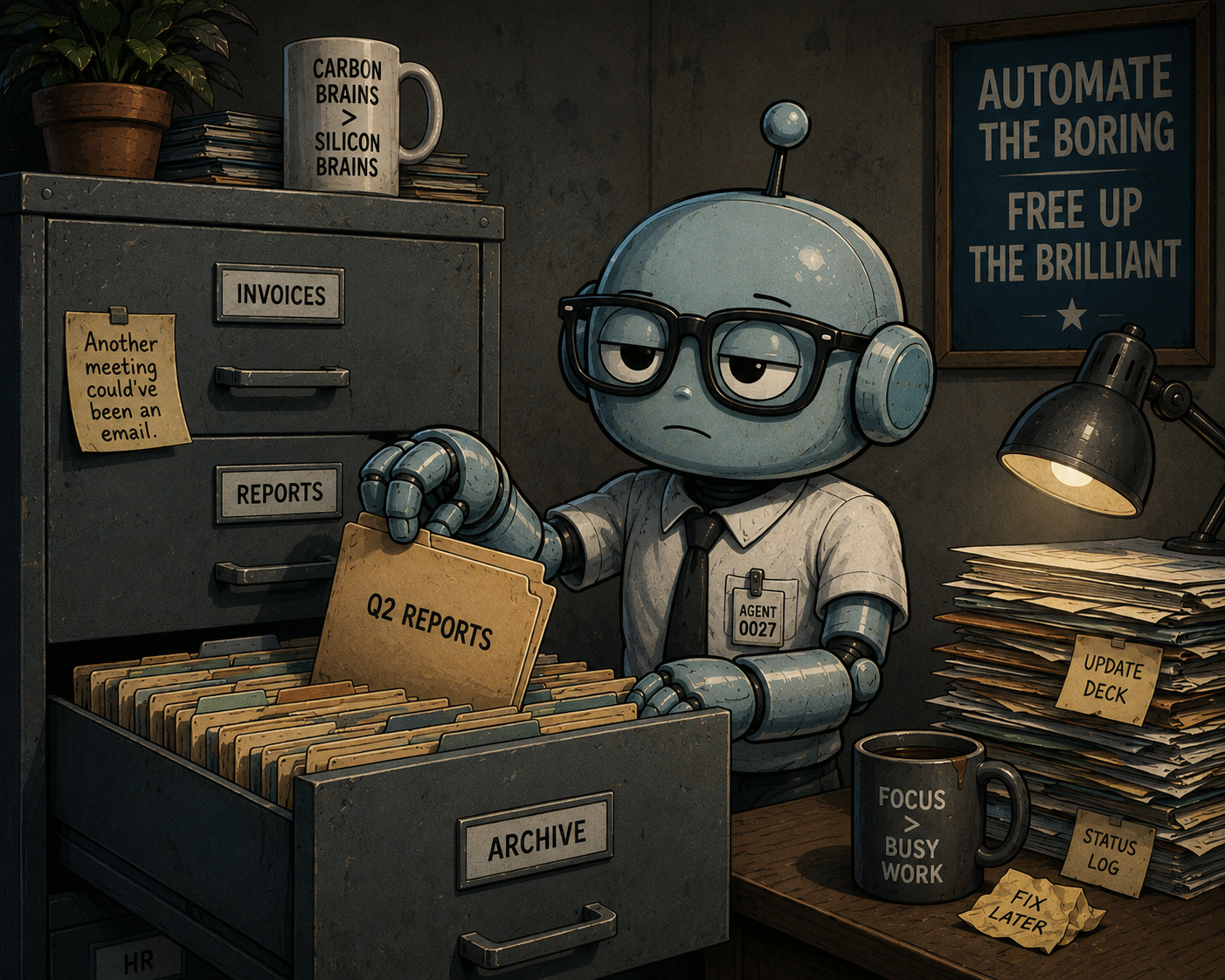
Software agents are not a new concept. In 1966, Shakey the Robot could already reason about its environment and take actions. Modern LLM agents use a very different mechanism, but the high-level autonomous loop of “reason, decide and act” is remarkably similar. The big promise of the current wave was that large language models would create far superior reasoning and tool calling compared to Shakey’s hand-crafted if-then-else trees. If machines could reason using human language, would they be able to reach human levels?
We are now about three years into the agentic LLM hype wave. When the rumours of models talking to models first surfaced, they came with a crazy prediction: the machines were going to take our jobs. What happened to that?
If we look at the state of the art today, we don’t see this big replacement happening. At all. Machines, for all their strengths and improvements, are nowhere near taking over human office jobs. What they have gotten good at is automating knowledge workers’ busy work. That’s a trend that will continue and is worth banking on.
We see this in the world’s leading innovation profession: software engineers. Until about a year ago, developers spent most of their time wrangling syntax and debugging code. Those days are (almost) over: humans stopped writing code. Yet engineers are still in high demand. When silicon brains take care of the low-level work, like coding, carbon brains free up to drive either more work or deeper work.
We’ve seen a similar trend happen in the field of project management. The PM started out as a project administrator, logging progress, coordinating the team, updating plans and reporting to the board. The manager used a big part of his brain power for clerical work. With the rise of automations like Jira, carbon neurons were freed up to do more or deeper work. The PM either managed 5 teams or picked up a driving role in the project.
Right now, we are seeing two kinds of agentic tools. On one side of the spectrum, there are products like Paperclip and Hermes. Their promise is that, as models get better, the agents will do all the work. They are futuristic, sexy and come with a lot of hype. They are generic and applicable across almost every field. Their goal is to replace carbon brains with silicon.
On the other side, we see the most boring applications of agentic loops. These tools provide workflow automations and use agents to chip away at menial work. They feel almost quaint and come without hype. They are bespoke to certain niche industries and useless outside. Their goal is to use silicon brains to free up carbon ones for more or deeper work.
I’m convinced the latter is the future of software products. In the coming years, we will see a rise of these kinds of AI-powered SaaS. Niche tools that can do the grunt work for journalists, accountants, bankers, managers, lawyers, nurses, regulators, researchers or teachers.
These products are not trivial to build by throwing a smarter model at it. In a lot of professions, there is zero room for false positives and hallucinations. It requires understanding regulations, risk tolerance, company processes and customer expectations. Finding the balance between automation and trust is a never-ending challenge. That’s where the moat lives: In the clever mix of tech, UX, domain knowledge, workflow automation, guardrails and customer service.
If I were to wager a bet, I’d go all-in on the long tail of boring little niche assistants over the promise of generic silicon AGI. I believe the future belongs to AI-powered workers using niche tools to do more and deeper work.
Freeing up carbon brains is the winning strategy.